Why choose No. 6 and No. 9 Extended Flap Remittance Envelopes over No. 9 Remittance Envelopes?
When it comes to your overall fundraising campaign success, many factors play a role, and one that often goes underappreciated is the choice of envelope to accompany your mailing. While selecting an envelope may seem like a minor detail, it actually has a significant impact on the outcome of your campaign. In this blog, we’ll explore why your choice of No. 6 and No. 9 Extended Flap Remittance envelopes may prove to be more effective than No. 9 Remittance envelopes in terms of usability, donor psychology, and mail optimization.
Understanding the implications of envelope size is crucial, as it impacts donor behavior, response rates, and processing efficiency. We'll cover how different envelope choices can influence your campaign's success.
Ready to Boost Your Direct Mail Response?
Get professional printing and mailing services tailored to your campaign goals.
Understanding the Different Envelope Sizes for Fundraising Campaigns
To appreciate the importance of selecting the correct envelope size, we first need to define the different types of envelopes commonly used in a fundraising campaign.
Size 6 Remittance Envelopes
Size 6 envelopes are small, typically measuring about 3.5 x 6.5 inches. These are often associated with lightweight correspondence, such as small contribution forms and marketing inserts. While these envelopes are compact and easy to handle, they are not ideal for larger or more complex donation pieces.
Size 9 Remittance Envelopes
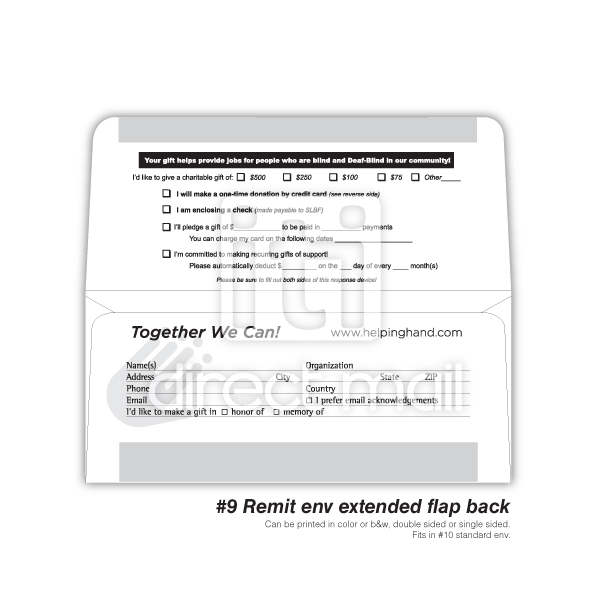
A bit larger than size 6, size 9 envelopes measure 3.875 x 8.875 inches. These are commonly used in reply mail for fundraising efforts, as they provide enough space to accommodate donation forms, checks, and other reply materials. Size 9 envelopes are available in both standard and extended flap options, with the extended flap providing a more polished and professional appearance.
Size 10 Envelopes
Size 10 envelopes are larger and typically used for outgoing correspondence, such as full-letter-sized letters. Though they offer plenty of space, they are not specifically designed for remittances. The primary issue with size 10 envelopes is that they can create confusion for donors, as they often resemble the original envelope sent out and not a return envelope.
Donor Interaction with Remittance Envelopes
An essential aspect of selecting the right envelope size is understanding how donors physically interact with the remittance envelope. The design of the envelope can significantly influence whether donors are likely to return their donations promptly.
Patterns of Behavior That Affect Return Rates
Once a donor opens the envelope, they are faced with the task of returning the donation. Envelopes that are difficult to use, either because they are too small or awkwardly designed, can lead to delays. Donors may hesitate if they feel that the form doesn’t fit properly or if they are unsure how to place their check correctly inside the envelope.
Usability and Donor Friction Points
The way an envelope is designed to handle donation forms and checks directly impacts donor behavior. If a donor feels rushed or uncertain about how to fold the form or place their check correctly, they may delay their donation or even forgo the process altogether. Small envelopes, like size 6, can exacerbate this issue by making the donor feel rushed and potentially frustrated.
Why Size 6 Envelopes Often Underperform in Fundraising Campaigns
Limitations That Contribute to Lack of Usability and Perceived Importance
Size 6 envelopes may be suitable for simple, straightforward correspondence, but they often fail in fundraising campaigns. The small size forces donors to fold their donation forms and checks excessively. As a result, the form is packed too tightly, which can unintentionally signal to the donor that their contribution is not as important. This reduces the urgency and emotional weight of their donation, leading to a decrease in response rates.
Why Size 6 Extended Flap Envelopes Are Effective for Simple Correspondence
While size 6 extended flap envelopes provide more space for folding, they are still insufficient for handling multiple pages of donation materials. Their size is simply too small to accommodate a variety of donation documents, making them less effective in complex fundraising mailings.
Why Size 10 Envelopes Are Not Ideal for Remittances
When Bigger Works Against Response Efficiency
Although size 10 envelopes offer plenty of space, they are not ideal for remittance purposes. One major issue is that size 10 envelopes are often mistaken for outbound mail, not reply mail. This confusion can lead donors to discard the envelope or ignore it entirely. The larger envelope may feel more like an outgoing letter than a return response, reducing its effectiveness in fundraising efforts.
Excess Space Reduces Perceived Structure
Size 10 envelopes often have too much space inside, which can lead to a lack of perceived structure when the donor receives the envelope. This confusion makes the donor hesitate, unsure of how to proceed with their donation. The excess space also weakens the clarity of the request, as the contents may feel unorganized and less urgent.
The Practical Advantage of Size 9 Remittance Envelopes
Designed Specifically for Fundraising Returns
Size 9 remittance envelopes are the ideal choice for most fundraising campaigns. They are specifically designed for use in reply mail, providing ample space to accommodate donation forms, checks, and other reply materials without excessive folding. The size is perfect for balancing usability with functionality, ensuring that donors can easily return their contributions without confusion.
Intuitive Donor Design
Size 9 envelopes are designed with the donor in mind. The proportions and layout of the envelope are intuitive, making it clear that this is the envelope where the donor should place their contribution. This design helps streamline the process, reducing hesitation and improving response rates.
Balance Between Visibility and Restraint
The size of the envelope is not too large or too small. It strikes a perfect balance between visibility and restraint. This balance motivates donors to respond quickly without feeling overwhelmed by an overly large envelope or dismissive of a too-small one.
Mail Processing & Backend Efficiency Benefits
For Whom Size 9 Envelopes Are Beneficial
Size 9 envelopes provide more than just an improved donor experience; they also enhance the efficiency of mail processing on the backend. Standardized envelope sizes, like size 9, make it easier for your fundraising team to sort, batch, and process returned donations quickly and accurately.
Fewer Errors in Handling
Because size 9 envelopes are standardized, they fit seamlessly into the mail sorting and processing systems used by postal services. This reduces the chances of misplacement or errors during handling, ensuring that donations are processed in a timely and efficient manner.
Smooth Donation Reconciliation
The consistency of using size 9 envelopes simplifies donation reconciliation. Standardized envelope sizes make it easier to track and process donations, speeding up the overall turnaround time and reducing the margin of error in your campaign.
Envelope Proportions and Psychological Signaling
Role of Size in Trust and Professionalism
The size of the envelope also plays a psychological role in how donors perceive your organization. Size 9 envelopes convey professionalism and preparedness, which can increase the donor’s trust in the organization handling their contribution.
How Envelopes That Are Too Small or Too Large Might Lack Polish
Envelopes that are too small, like size 6, may feel informal or rushed, while envelopes that are too large, like size 10, may appear excessive or wasteful. Finding the right balance in envelope size is crucial for maintaining professionalism and trust with your donors.
Postal Service: Mail-Sorting and Cost Efficiency
Blending Response Optimization and Mailing Economics
The optimal envelope size that balances response optimization and mailing economics is size 9. These envelopes are compatible with standard postal automation systems, which ensures that mailing costs are predictable and accurate. This helps with budgeting for large-scale mailings and prevents unexpected postal surcharges.
Consistency is Important in Mass Mailings
Standardizing the envelope size across your mailings helps maintain consistency in your operations. It also ensures that your campaign avoids costly postal surcharges for oversized envelopes, making your mail-outs more cost-effective.
When Size 6 or Size 10 Might Still Be Relevant
Exceptions Rather Than the Rule
While size 9 envelopes are generally the best choice for most fundraising campaigns, there are a few exceptions. Size 6 envelopes might be required for very small donations or for minimal reply cards. Size 10 envelopes might be used for specific donor segments that demand a more elaborate package. However, these are exceptions rather than the rule when it comes to fundraising efforts.
The Role of Envelope Size in the Overall ROI of the Campaign
Small Physical Decisions, Big Financial Consequences
The size of the envelope plays a direct role in your campaign’s overall ROI. Small improvements, such as streamlining the donation process by selecting the right envelope size, can lead to significant increases in response rates and overall return on investment. Optimizing envelope size for ease of use is a key factor in maximizing fundraising success.
Conclusion: Making the Size 9 Choice With Confidence
In conclusion, size 9 remittance envelopes offer the best balance of usability, mail optimization, and donor engagement. By choosing size 9, you can improve response rates, reduce handling errors, and increase overall campaign efficiency. With these advantages in mind, selecting the right remittance envelope size is crucial for fundraising success.
Letter Printing has experienced direct mail professionals who understand the importance of envelope choice and can help guide you in selecting the right envelope for your next fundraising campaign.
Written by The Letterprinting Team | 29 December, 2025


