Handwritten Address Envelopes
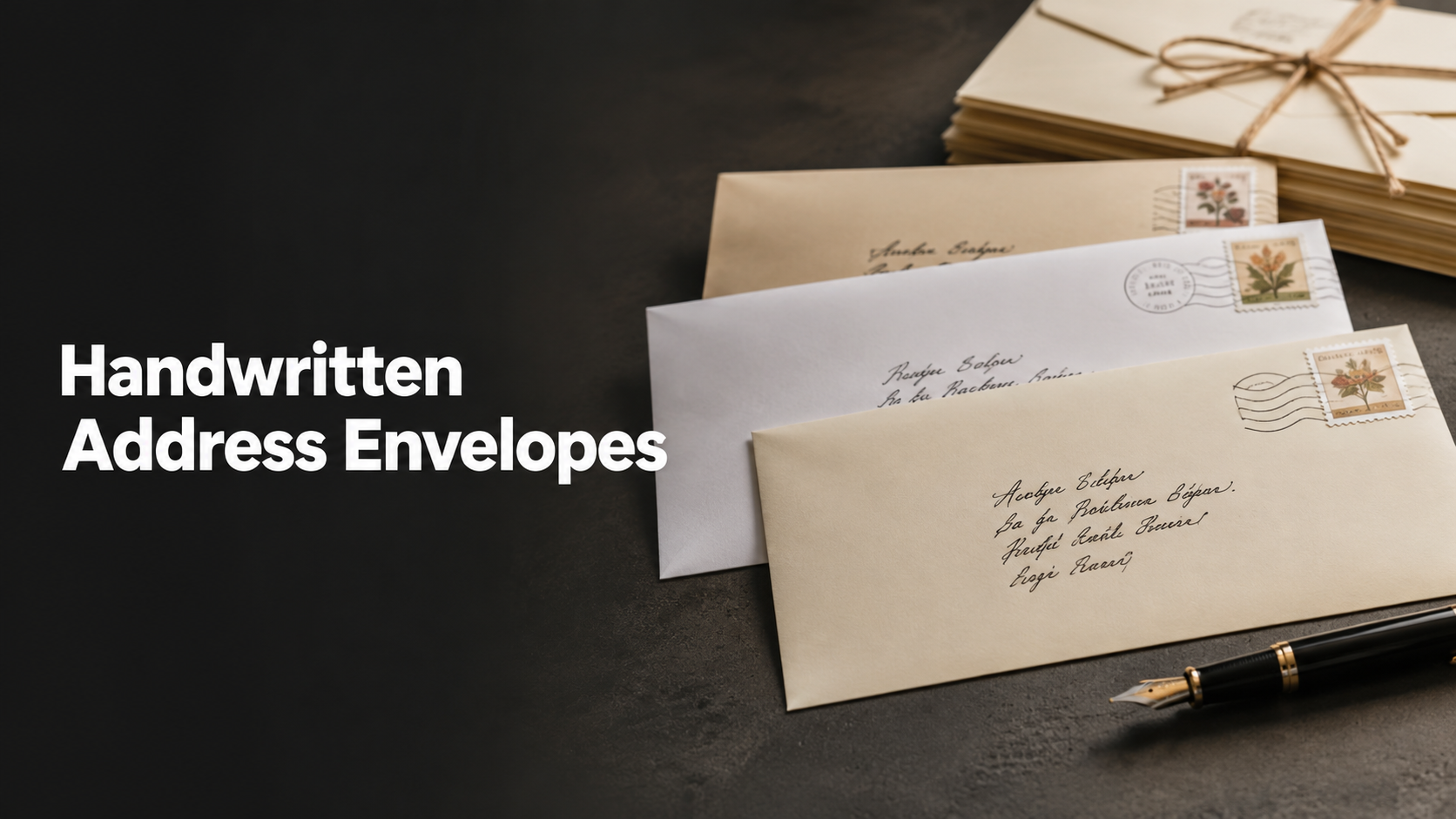
Handwritten Address Envelopes That Actually Get Opened
If you're tired of watching your direct mail get tossed unopened, handwritten address envelopes might be exactly what your campaign needs. There's something about seeing your name written by hand, rather than printed in a generic font, that makes people pause before they toss the mail aside. It looks personal. It looks like it came from someone, not something. That small psychological shift is often the difference between a letter that gets opened and one that ends up in the recycling bin. Whether you're mailing to prospects, clients, or donors, handwritten address envelopes give your message a real shot at being seen, read, and acted on, rather than sorted straight into the trash with the rest of the day's junk mail.
Why Handwriting Still Works in a Digital World
Almost everything we receive these days is digital, so genuine handwriting has become rare, which is exactly why it stands out. People sort through their mail quickly, tossing anything that looks like an obvious mass mailing before they've even really looked at it. A handwritten envelope disrupts that habit immediately. It doesn't look like a bill or a circular; it looks like something worth opening, something personal enough to deserve a second glance.
This isn't just a hunch, either. Recipients consistently respond better to mail that feels personal rather than mass-produced. When someone sees their name and address in a natural, flowing script instead of a robotic font, it signals that a real effort went into reaching them specifically, even if the letter inside is part of a much larger campaign. That perception of effort translates directly into higher open rates, which is ultimately what every direct mail campaign is trying to achieve in the first place.
Think back to the last time you found a handwritten envelope in your own mailbox. There's a natural curiosity that kicks in immediately, a moment of wondering who it's from before you even open it. That curiosity is precisely what marketers are trying to recreate at scale, and it's why this simple detail continues to outperform standard printed addressing year after year.
Ready to Boost Your Direct Mail Response?
Get professional printing and mailing services tailored to your campaign goals.
How the Process Actually Works
You don't need a room full of people handwriting envelopes one by one. High-resolution fonts designed to mimic natural handwriting are used to address each envelope through inkjet printing, giving every piece that authentic, personal look at scale. The variation between letters looks genuinely handwritten rather than robotic or repetitive, so recipients can't tell it wasn't done by hand, even up close.
Beyond addressing, handwritten-style notes and comments can also be added to printed materials inside the envelope, giving the entire piece a cohesive, personal feel from the outside in. A handwritten envelope paired with a printed letter that looks obviously mass-produced can actually feel disjointed, so extending that personal touch to the letter itself helps maintain the illusion, or rather the genuine feeling, of individual attention throughout the entire piece.
If you have your own handwriting you'd like to use instead of a stock font, it can even be converted into a custom font unique to your brand, so every future mailing carries your own signature style. This is particularly valuable for businesses built around personal relationships, where a recognizable, consistent handwriting style becomes part of the brand itself over time.
No Extra Cost, Just a Minimum Order
Handwritten-style addressing doesn't come with an added fee. It's included as part of your mailing at no additional charge, as long as your order meets the standard minimum of 50 pieces. That makes it accessible for smaller, more targeted campaigns as well as larger mailings, without pricing anyone out of a strategy proven to boost open rates.
Real postage stamps can also be paired with handwritten-style addressing for an even more authentic feel, since a stamped envelope looks noticeably different from one with a metered postage mark. Metered mail has become an instant visual signal of a mass mailing, something recipients have learned to filter out almost unconsciously. Combining a real stamp with handwritten-style addressing removes both of those red flags at once, giving your envelope the best possible chance of standing out in a crowded mailbox.
Where Handwritten Envelopes Make the Biggest Difference
Handwritten address envelopes tend to perform especially well for real estate outreach, nonprofit fundraising appeals, and any campaign where trust and personal connection matter. Yellow letters, a format long favored by real estate investors, frequently pair handwritten-style envelopes with their printed letters to maximize open rates, since the entire strategy behind yellow letters is built around feeling personal rather than corporate.
The same logic applies to donor mailings, where a personal touch can meaningfully increase response. Nonprofits in particular benefit from this approach, since donors are far more likely to open and read something that feels like a genuine, individual outreach rather than a form letter asking for money. Even outside those specific use cases, any business trying to cut through mailbox clutter benefits from this approach. If your current campaign relies on plain, printed envelopes and response rates have plateaued, switching to handwritten-style addressing is one of the simplest changes that tends to move the needle without requiring a complete redesign of your entire mail piece.
Combining Handwritten Envelopes With Your Full Mail Strategy
Handwritten address envelopes work best as part of a broader direct-mail strategy rather than as a standalone technique. Pairing handwritten-style addressing with mail merge personalization inside the letter creates a consistent experience from the outside in. Instead of opening a personal-looking envelope and finding an obviously generic message, recipients receive content tailored to their names, locations, interests, or previous interactions.
Mailing frequency is also important. A single handwritten envelope may improve visibility and encourage more recipients to open it, but a consistent mailing schedule can build meaningful recognition over time. Recipients may begin associating the distinctive handwritten appearance with your business, particularly in industries such as real estate and nonprofit fundraising, where repeated communication with the same audience is common. Across several mailings, that familiarity can support stronger engagement and response rates.
Businesses planning larger campaigns may worry that handwritten-style addressing will slow production compared with standard printed envelopes. In practice, the high-resolution inkjet process used by iti Direct Mail applies handwritten fonts at standard production speeds. This means businesses can achieve a more personal presentation without creating a significant production delay or extending the normal turnaround time.
The strongest campaigns combine handwritten addressing with relevant messaging, personalized content, an appropriate mailing schedule, and a clear call to action. Tracking responses through dedicated phone numbers, landing pages, QR codes, or offer codes can also reveal which messages and audience segments produce the best results.
Ready to make your envelopes stand out? Explore available handwritten fonts for your next mailing, or convert your own handwriting into a custom font today.
Frequently Asked Questions
Are handwritten address envelopes actually handwritten?
They use high-resolution fonts designed to closely mimic natural handwriting, applied through inkjet addressing. The variation between characters looks authentic, giving recipients the impression of a real, handwritten envelope.
Is there an extra cost for handwritten-style addressing?
No. It's included at no additional charge as long as your order meets the standard 50-piece minimum.
Can I use my own handwriting instead of a standard font?
Yes. Your handwriting can be converted into a custom font, so future mailings carry a consistent, personal style unique to your brand.
Does this work with real postage stamps too?
Yes, real postage stamps can be paired with handwritten-style addressing for an even more personal, less obviously mass-mailed appearance.
What kinds of mailings benefit most from handwritten envelopes?
Real estate outreach, nonprofit fundraising, and yellow letter campaigns see especially strong results, though any mailing trying to boost open rates can benefit.
Ready to boost your open rates? Explore handwritten fonts for your envelopes or convert your own handwriting into a custom font for your next campaign.
Revised 17 August, 2026


